Monday, May 17, 2010

Spellbound

Since watching a clip of Spellbound in class, I have watched the documentary three times. Not because I thought it was the best movie ever, but because I kept taking away different things whenever I'd watch it.

The first time I watched it was because I wanted to see it, it seemed cute and funny in class and I wanted to see the whole thing. However I was multitasking while watching it and didn't give it my full attention. It was enjoyable, but I couldn't say much past that. The next time I watched it was when my boyfriend was in town. We wanted a movie to watch, and I was trying to figure out how to break him into documentaries. I loved what Diane said about how Spellbound "is a good one to show your mom, so she knows what you're doing in film school. She'll think it's cute." Works the same with boyfriends.

It really is a light-hearted, straightforward and simple structure - kids in spelling bees, let's look at each of them and follow them to the National Bee. I think it's a great way to break someone into the idea of a non-fiction feature, like family and friends who don't know much about documentaries.
However, when I watched it with him I would get tense or frustrated if I felt like he missed a line or a doc convention that was cool or worked really well. It stressed me out so I watched it a third time by myself. The last time I really wanted to look at how they constructed each main kid as a character. I'm mostly interested in portrait and personal documentaries, so I'm trying to watch a bunch and see what things I like about some docs over others, what works, what doesn't, etc. For example, there were definitely some families that I was more drawn to and interested in than others, and some kids I'd rather spend time in their space and psyche than try to show a lot of their family or town if I didn't think it was as strong.

I really did like this movie though, I think it's something that makes documentary filmmaking feel more accesible because of its ease of story and event (though it could've been a a horrific process, who knows) and the likability of its protagonists.

The September Issue

The other day I was tired and in a bad mood so I thought I'd watch a low-impact, not too serious of a documentary and multitask by playing solitaire or something. And alas I came across The September Issue, a documentary about putting out an issue of Vogue. Simple and low-impact enough, right? Well, I didn't play any solitaire and have bought 3 issues of Vogue since. Sigh, I'm such a target for persuasion and consumerism.

The film documents the process of putting together the magazine's September issue, their most important and largest issue of each year. Though I'm known for liking clothes, I never follow the fashion industry - big names, how it works, etc. So this documentary blew my mind in terms of realizing what a HUGE and complex industry designer fashion is, the amount of money at stake, the power dynamic between people and companies, the power it has over consumerism, etc. The piece was not just a portrait of Vogue itself, but rather it's mysterious Editor in Chief Anna Wintour. Wintour has had this job for 22 years, and is 60 years old. She is a tiny, skinny 60 year old woman, and after watching this documentary, if I saw her on the street I'd turn a corner. The film as a whole was made to diffuse some of the mystery about Wintour and also give a backstage look at how Vogue works. I can't say I walked away with any life lesson or a changed perspective on anything, but filmmaker R.J. Cutler did a great job of capturing the essence of a world, industry, and idol of which I am completely unknowledgeable, and making me captivated viewer.

Though consistently interesting, I'd say one thing I felt was missing was a larger number of cohesive scenes and moments. The film does cover a great number of months, and has a lot it wants to show the viewer, but after a while some of the scenes and processes it was showing us (Anna reviewing photos from shoots, meeting with famous designers) seemed stringy and repetitive in topic, structure, and emotion. Every time a new facet to the world or magazine was introduced it was fascinating, but to keep coming back to similar things and not new ones caused the piece to start losing momentum.

Wintour is a mesmerizing lady, and I've been told that she did this documentary is a big deal, but by the end of it she wasn't as humanized as I would've expected or as I'm used to with documentary main characters. I understand that it's part of her personality and reputation to not be the most relatable person, surely she's not, and I'm amazed that this tiny 60 year old woman literally runs the fashion industry. But at the end of it, as a fashion outsider, I just felt kind of bitter that this is what she gets to do as her job, and the whole industry is this big crazy organism that I will never understand.


The Eyes of Me

This was my first outside event, back in the day. But if I can make any excuse for forgetting to write about my outside events as they happened, it's that instead of writing my immediate reaction, it's interesting (at least to me) to see what I ended up taking away from it and what I remember.

I haven't had any experience in animation, and haven't really had much exposure to it at all as a artistic implement in film, especially documentary. I had a love/hate relationship with the animation in The Eyes of Me. I think it was great as, not so much a representation of what the blind 'see' (since we can't say exactly), but rather in expressing the fact that they experience things much differently than seeing people. Obviously showing gray shapes when the character says something was blurry or foggy isn't a perfect representation how how she felt or what she saw, but it's a small step in creating an idea in the mind of the seeing of how the blind and visually impaired see their experiences and feelings, or even things as basic as glimpses of shape and light. There were a couple times that I felt like the animation was unmotivated, and I would've liked it to either be more pervasive or strictly limited to when the main characters were describing their visions, memories, dreams, etc. Because when it did feel unmotivated, I was concentrating more on the animation itself and not the character or story. The director did say he knew from the start he wanted to animation, and specifically that style of animation "because it's so cool".

Something that really blew my mind is that this was the first documentary from both of these filmmakers. They had a really great partnership though, and the Q&A afterwards was really inspiring and revealing (COMPLETE opposite of the Blaze Foley Q&A, thank goodness). Also, the story that we watch in The Eyes of Me is not the story they originally set out to make. I think I'm still a little ignorant about the time and process required when it comes to documentary production. I tell myself I know what's involved, but I don't think I'll truly be able to understand or respect it to its fullest until the day I'm trying to make my own feature documentary and I hit road blocks like they did - "Yeahh, this story's not working. What do we do instead...after all this time we've spent on this...."

A Veiled Revolution / Quest for Honor

Going to this screening, I didn't know A Veiled Revolution ( AVR) would be showing before Quest for Honor, and I was pleasantly surprised that it was a bit dated (just in time, not topic). It was beautiful and relavant, and compared to Quest for Honor had a hint of an archival look, that of course I loved so much. Some of the interviews are what really got me. To hear from the Egyptian women themselves from decades ago, who were all passionate and had different opinions amongst each other got me riled up that we have such strong opinions on them and their dress. Why do we care?? Why do we think we know what's best for them? The Egyptian women in the 1920's were the first to go in public unveiled. They already had a feminist movement from which came a change in dress. Starting in the 70's and continuing on, some women have started going back to the traditional 'Islamic dress', but by choice. I feel like our culture is incapable of viewing and understanding the Islamic dress as a choice and a personal statement. I'm sure that some women today would secretly confess that it is not their choice to wear it, but besides that, traditional Islamic dress is not required nor oppressive to all who wear it. I was really hit by those women who explained their move back to Islamic dress as a move to become closer to God and saving their appearance for their families and husband. This isn't something I would do or can relate to necessarily, but made me realized how incredibly ignorant we can be about other cultures, over and over across decades. After the screening that night I was on the phone with my boyfriend and we actually got in a fight about it. He was under the impression that it isn't fair and is oppressive. I'm typically the borderline feminist and would usually enraged about things like shrouding and the idea of Islamic dress. However, to see how passionate some of the women were about their choices, whether I'm on the same page as them or not, made me realize how muddled my own world views are of women in other cultures. After this film, I don't love or understand it completely, but I have a much higher respect for the women who believe in their culture and their morals and make such choices.

The main film screening, Quest for Honor, was also very good. I will admit, I remember much more about AVR than the feature. However my favorite idea or topic of the documentary was the movement for women's education, networking, and resources. In the past few years I have become much more interested and invested in women's rights, organizations, and resources so after the film my first reaction was wanting to show up and help at the women's center in the film. There was something very important and emotional in seeing women learning about politics in the mosque and reading the women's newspaper, while wearing traditional Islamic dress, especially after just learning about it in AVR.

Previously Unknown: The Legend of Blaze Foley

I'm going to write my outside event posts in backwards chronological order of their happening. Sorry for not writing right after I went to them.


Previously Unknown: The Legend of Blaze Foley is a biographical documentary about muscian Blaze Foley. I had never heard of Foley, and by the looks of the other people at the screening, his biggest fans are not exactly in my age bracket. In general I enjoyed the screening, but it was by no means one of my favorite docs, nor in a style that I would ever make one. The director, Kevin Triplett (no relation) has been working on this film for 10-12 years now. That makes my head and heart hurt. Foley was already deceased by the time he started, and Triplett didn't know or listen to Foley's music when he was alive. I thought that was really interesting, and was dying to know what motivated him to get into this topic and make this film. Surely something make him crazy passionate, otherwise how could've he have stuck with it for this long? But, when asked at the Q&A, Triplett responded, "I don't know why I made this documentary." ...And he was dead serious. He was interested and proud of his work, and yet seemed oddly apathetic on many levels.

The doc chronicled Foley's life and broke it down into chapters, 'The ___ Years" (insert where he was living or name he went by at the time). Every now and then it would cut away from the interviews and typical doc form into what appeared to be clips of a TV special done on Foley. However it was all part Triplett's own work. There were also fake commercials for Foley's CDs or compilations. They were funny, but for me were really jarring and distracting. Even the TV program format confused me sometimes. It was an entertaining and creative take on the feature doc, taking all these different elements of biographical programming and putting them together, but I don't know if I love it.

Also something I didn't really like, was the panel who joined the director were all people who'd appeared in the film, and all knew Foley when he was alive, and the crowd was full of friends and fans, so the Q&A turned into story time, inside joke swapping, and reminiscing about Foley. That's all fine and dandy, but I felt like I wasn't supposed to be there, it was kind of awkward. And Triplett couldn't relate either, so we weren't even talking about the film. The woman on the panel apparently used to date Foley, but only one relationship of Foley's was represented in the film, and it was just really awkward and confusing for her to be bringing up all these stories of the two of them. She even said 'I love her (the wife/girlfriend), but Blaze HAD other girlfriends'. I don't know, it just didn't seem like that was the discussion that needed to be going on after the film.
But anyway, I did enjoy it, and loved all the archive video and photos they had of Foley. Check it out and support K. Triplett!

Crooked Made Straight (2010)

CROOKED MADE STRAIGHT (2010) is a documentary exploring the life of an American doctor practicing in Ethiopia. The documentary is short but it packs a lot of information in a short amount of time. Out of the recent documentaries I've seen I would have to say this one kept me to most interested through out. Seeing many unfortunate medical conditions plaguing Ethiopians young and old truly was heart wrenching.


One of the main reasons as to why I was interested in the story of the film was the fact that it was primarily cinema verite type scenes. It showed him interacting with his patients. You could see his compassionate behavior in the way he dealt with them. There were interviews, but they were kept at a minimal level and did not overbear the narrative information. Additionally, the film's editing and sound design was very well done in that I did not notice any abrupt distractions from the flow of the film. The pace and transitions were very smooth throughout from beginning to end.

The primary allure to this documentary is that it is in a new environment, very different from the day to day life I experience. However, the film has little development in terms of an obvious narrative arc. It is more of a slice-of-life type documentary, which makes sense because of the length. I feel as though that the documentary still could have explored the doctor's personal struggles, etc.

Overall, the documentary was very intriguing and thought provoking due to its dealing of a new environment and by utilizing scenes of a verite style although more development in terms of personal conflict-resolution would have made the film all the more compelling.

No Impact Man: The Documentary

I first heard about the No Impact Man on the Colbert Report, so I found it funny when I watched the film that the first image you see is of The Colbert Report awning, and begins with his appearance on that show, then goes back 5 months to tell the whole story. With the influx of enviromental and green indivuals pieces that have gotten more popular in the last few years, I was a little skeptical of this project at first. However, I think it was a nice balance of 'big picture' and family photo. In short, Collin and his family took a vow to have no impact on the environment for an entire year - making no trash output, eating only natural food and flavors that came from within 250 of their home (in Manhattan), not using electricity, not using public transportation, not buying anything new, etc. Collin brought up the mantra of Reduce, Reuse, Recycle, and basically said, how much easier would it all be if we just could reduce our usage to none? Some say this is impossible, but you really just have to have the will.

Starting with showing all of the news coverge Collin's gotten and his television appearances and notoriety sets up the importance and success of his idea, instead of having the viewer feel like they're beginning with him and don't know the outcome. The combination of the intro and the fact that a three person family living in New York City is trying to go green (to the absolute extreme of the word) felt like a unique experience and story to be a part of as a viewer.

Right away the wife is introduced as a source of conflict (in terms of narrative). I was definitely rooting for her throughout, partly because marital conflict makes me uncomfortable, so I wanted her to participate and for them to get along, but also because I can see myself in her a bit, and I wanted to know that there was hope for people like us to change our ways. Collin is presented as an overly glorified savior of the enviroment (my opinion), and his wife is the average American consumer. This sets up a perfect mirco level struggle to play along with the bigger environmental themes that are emphasized. Often times I felt like she was unfairly picked on or portrayed, especially when they'd bring in the overly adorable toddler to take sides with the dad. That's not cool. But the wife did make a lot a progress, learned a lot, and was able to express herself throughout the process instead of going along with whatever Collin told her to. This was important because how Collin is portrayed makes the process look WAAAYY too easy. The wife is a good example of 'it's not easy, but there ARE things you can do to help, you can change your ways for the better even in small steps'.

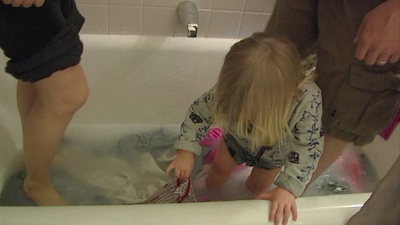
Something that this documentary did well was create these amazing scenes within the scope of this larger project. That's something that Diane always stresses, is creating scenes and moments that are meaningful to the bigger picture, then building those together to tell the story. I really saw that apparent in this piece, as almost all of the small moments and scenes could've been short portraits or vignettes of this family. One of my favorites is shown in the picture above, and is where Collin has just thrown out all of their cosmetics and bathroom goods, and has made his own laundry detergent. Meanwhile the wife is in bed rolling her eyes and getting stressed out about losing all these things she's used to. Collin is doing the laundry in the bathtub and teaching his toddler how to wash the clothes by stepping on them. Finally the wife comes in to see what's going on and ends up rolling up her pants and getting in the tub with the rest of the family, the scene ending with Collin kissing his wife. SOOO cheesy and cutesy, but it really is a moment, and the film is full of great scenes like this. (There are a couple that are cheesy/cutesy and don't really add, such as the toddler learing about fireflies. Cute, but we get it, you have a cute daughter, let's move on.)

After watching this film, I'm not going to try to go no impact or anything, but it did shake me up a bit, especially in how I could relate to the wife about some things. We have the same weakness - clothes. She is a designer junkie, and I am far from that. Everything I buy is used or extremely inexpensive. However, I use that as the excuse for purchasing things WAY too often. This documentary made me very aware of how much STUFF I have. It's kind of painful. I need to follow her theory of 'inventory reduction'.
Overall, the doc was good. I learned a lot, and like the Characters. Check it out.